

Nutrition without Borders
Plant the Seeds of Knowledge, Harvest the Future
BACKGROUND
In many regions of northern Ghana, access to healthy nutrition is not a given. Long dry periods, increasingly unreliable rainfall and the fact that there is often only one short rainy season per year lead to low agricultural yields. As a result, many families are unable to provide themselves with sufficient nutrient-rich food.
Children are particularly affected. They lack essential vitamins and a balanced diet, both of which are crucial for their physical and cognitive development. At the same time, many schools lack in-depth knowledge about what healthy nutrition actually means and how local foods can play a key role.
What is missing is the connection between knowledge, practical implementation, adaptation to changing climatic conditions and sustainable structures.
PROJECT
Together with the Stiftung Essen Wissen, we have developed a pilot project that addresses exactly this gap.
By combining nutrition education with sustainable agriculture, we bring together two elements that belong inseparably: food and knowledge. Our goal is to create long-term food security while empowering people on the ground to take their future into their own hands.
“Nutrition without Borders” is a holistic approach. We connect education with practical implementation and create a system designed to last.
The project targets schools, teachers, children, local farmers and entire communities in the Northern and Savannah Regions. Our approach remains consistent: we develop solutions together with local communities and build structures that can continue independently.
IMPLEMENTATION
The project consists of two core components that complement each other:
- Nutrition Education in Schools
We start with grades 1 to 4. Children learn in an age-appropriate way how nutrition works and what their bodies need. Through interactive lessons, hands-on activities and supporting materials, knowledge becomes tangible and easy to understand. At the same time, teachers are trained to ensure that this knowledge is sustainably integrated into everyday school life. In the first phase, the program will reach 100 schools, forming the initial cohort of the project. - Sustainable Agriculture
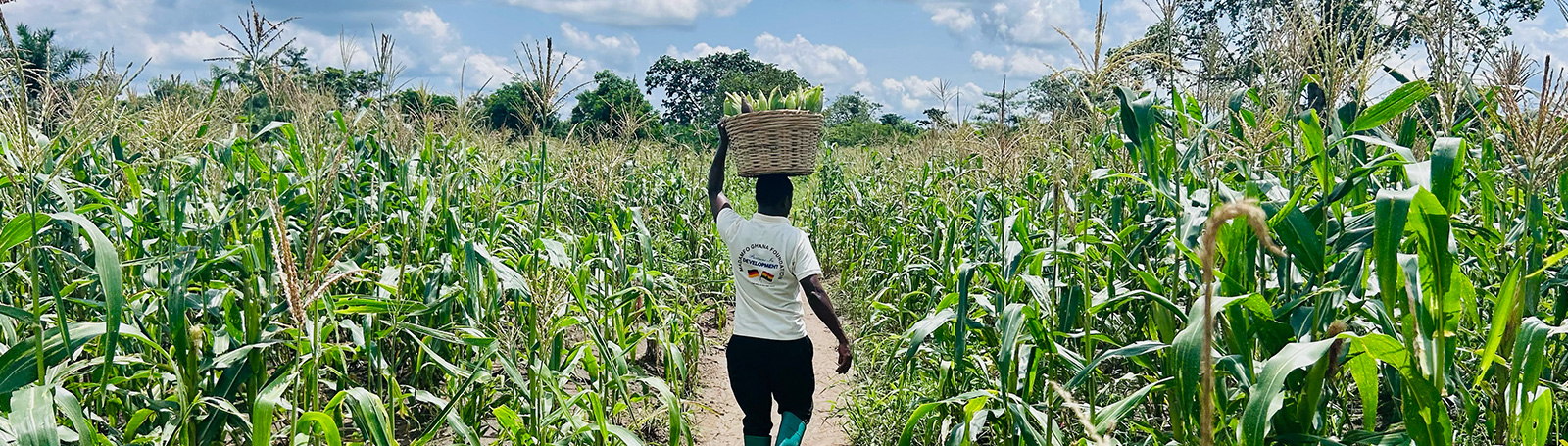
In parallel, we are establishing a demonstration farm, starting with 20 hectares, with the goal of expanding it over time. Implementation will begin with the next rainy season in June/July 2026. The farm will cultivate nutrient-rich crops such as orange-fleshed sweet potatoes and maize, while also introducing climate-resilient farming methods.
The farm is not only a place of production, but above all a learning environment. Farmers, communities and project teams are actively involved, trained and empowered to build their own structures.
In the long term, a local cooperative will take over management and marketing, ensuring that the project continues independently.
IMPACT
Our approach creates impact on multiple levels.
Children gain access to better nutrition and learn early on what healthy eating means. Teachers pass on this knowledge and anchor it sustainably within the education system. At the same time, the availability of nutrient-rich food in communities increases.
By building sustainable agricultural structures, new income opportunities are created, especially for young people and women. Regional markets are strengthened and local value chains are developed.
In the long term, a system emerges that sustains itself:
Knowledge that is passed on.
Agriculture that works.
And communities that shape their own future.


